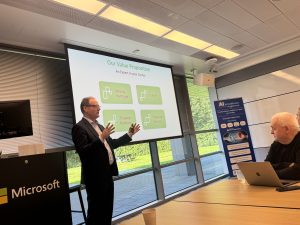

Authored by Gerry Kerr, Microsoft Practice Director.
Azure is no longer simply a destination for infrastructure. It has become a foundation for how organisations innovate, scale, and make better decisions. As AI becomes embedded in day-to-day operations, the role of cloud is shifting from a technical choice to a strategic requirement.
This article outlines a practical approach to Azure migration, focusing not just on moving workloads, but on enabling long-term transformation.
From Cloud Adoption to AI Transformation
Since 2008, when Microsoft first introduced Azure, organisations have had to weigh the advantages of cloud versus on-prem infrastructure. For many, the initial driver behind cloud migration was cost reduction and infrastructure modernisation.
Today, that conversation has shifted. The rise of AI has moved cloud from being primarily an IT decision to a broader business consideration. Increasingly, the question is no longer whether to move, but whether the business can continue to compete without it.
Azure now sits at the centre of that shift. It provides a platform for innovation, automation, and data-driven decision-making, while creating a flexible foundation for future change.
A Strategic Approach to Azure Migration
Adopting Azure successfully requires more than a lift-and-shift exercise. In practice, it is closer to a digital transformation programme, where technology decisions are aligned to business outcomes.
By making use of platform services, cloud-native capabilities, and modern data platforms, organisations can achieve efficiencies that are difficult to replicate in traditional environments.
At HCS, we typically recommend a structured approach based on Microsoft’s Cloud Adoption Framework, ensuring migration is planned, governed, and outcome-driven.
Define Business Outcomes First
- What business challenges are we addressing?
- Where can AI create a meaningful advantage?
- What outcomes are expected in terms of cost, speed, or innovation?
Starting with business outcomes ensures that cloud adoption delivers measurable value.
Assess and Rationalise Your Existing Estate
- Quick wins with low-risk migration opportunities
- High-value workloads for modernisation
- Legacy systems requiring redesign
- Opportunities to transition to SaaS
A structured assessment helps prioritise effort and align migration with business need.
Build a Secure Landing Zone
- Identity and access management
- Security and governance controls
- Networking and connectivity
- Operational standards
A well-designed landing zone ensures compliance, cost control, and scalability from the outset.
Migrate and Modernise in Parallel
- Move towards cloud-native architectures
- Reduce technical debt
- Embed automation and resilience
This approach helps ensure long-term value rather than simply relocating existing challenges.
Optimise Continuously with AI
- AI-enabled cost and performance optimisation
- Dynamic scaling aligned to demand
- Increasing automation over time
In the AI era, optimisation is ongoing rather than a one-off activity.

Top Five Reasons to Consider Azure
1. AI-ready infrastructure at scale
Azure brings infrastructure, data, security, and AI together, enabling organisations to adopt new capabilities without repeated redesign.
2. Agility and scalability
Azure allows organisations to scale resources in line with demand, enabling faster response to change.
3. Security and compliance built in
Security and governance are built into the platform, supporting a structured and controlled approach to risk.
4. Cost optimisation
Flexible, usage-based pricing models help align costs to actual business demand.
5. Unified platform
Azure provides a consistent platform for infrastructure, applications, data, and AI, supporting better decision-making.
Conclusion: From Migration to Transformation
Moving to Azure is no longer just a technical exercise. It is a broader business decision focused on improving how organisations operate.
Rather than asking how to move to the cloud, organisations are now asking how to use it to become faster, more efficient, and more competitive.
Start the Conversation
If you are planning your next step with Azure, HCS can support you with a structured, practical approach to migration and optimisation.
Talk to our team to explore where to start and how to realise value from your cloud investment.