

Authored by Lesley Whelan, Head of Risk & Compliance.
For many organisations, compliance is still viewed as something they have to do. A necessary requirement. A box to tick. A task to complete before getting back to the work that really matters.
The reality is quite different.
The organisations getting the greatest value from governance and compliance are not treating it as a regulatory obligation. They are treating it as a business capability. It is being used to improve decision making, build customer trust, reduce operational risk and support growth. That is because governance isn’t really about compliance at all. It’s about confidence.
Confidence in your decisions. Confidence in your controls. Confidence that your organisation is prepared for whatever comes next.
As regulatory expectations increase, cyber threats evolve and technologies such as AI reshape how organisations operate, that level of assurance has become increasingly important. Governance, risk and compliance are no longer topics reserved for auditors and regulators. They are now business priorities that sit firmly on the agenda of leadership teams and boards.
From Compliance to Confidence
At HCS, we often encourage organisations to think about governance through a different lens.
Instead of asking, “Are we compliant?”, we ask: “Does our approach to governance give the business confidence to move forward?”
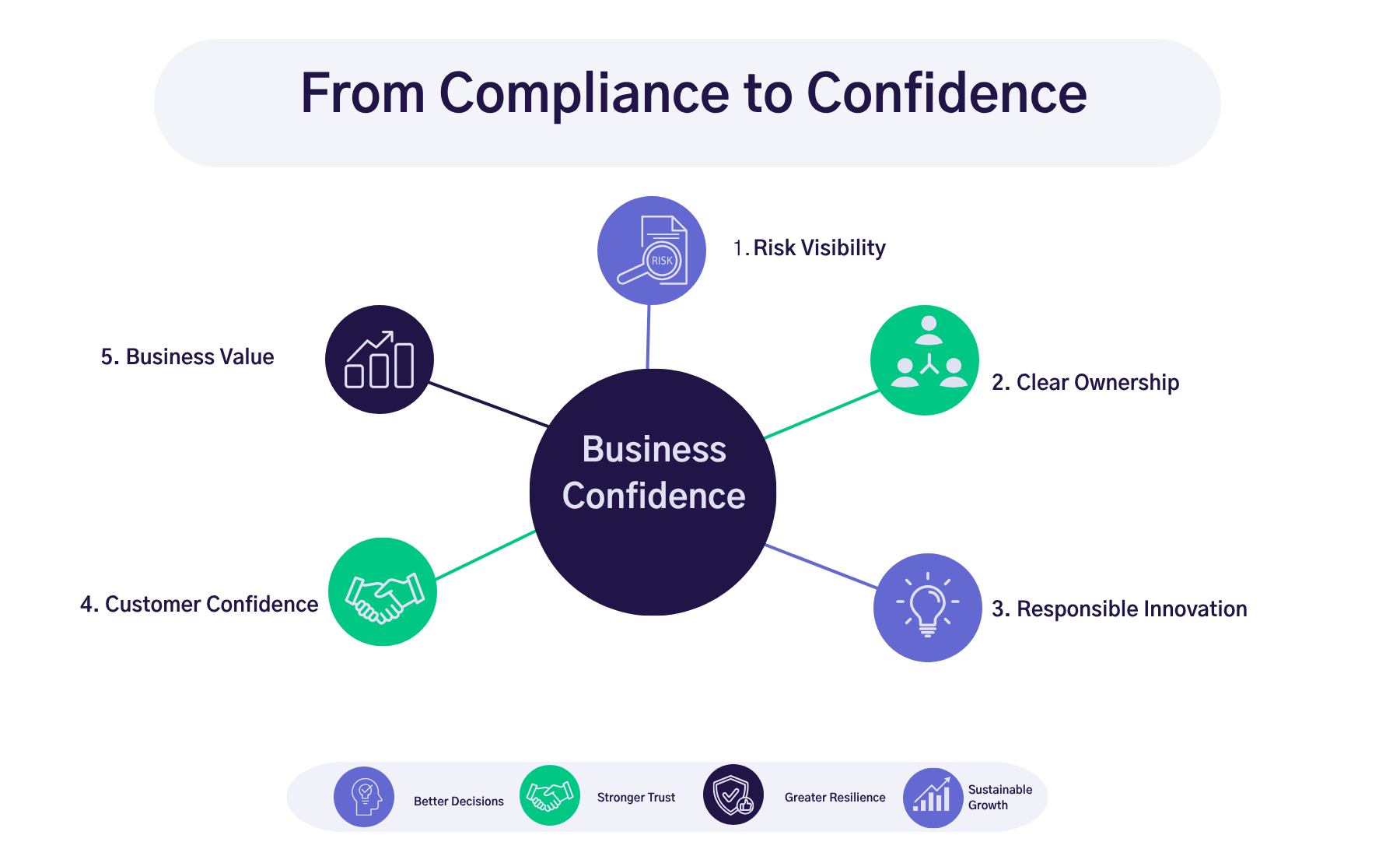
Organisations that successfully make this shift tend to focus on five key areas.
1. Risk Visibility
Every organisation faces risk, whether it’s cybersecurity threats, regulatory change, supplier risk, operational resilience or emerging technologies such as AI.
The challenge isn’t identifying every conceivable risk. It’s understanding the risks that matter most and ensuring they are visible to the people making decisions. Without visibility, organisations tend to react to issues. With visibility, they can plan, prioritise and make informed decisions.
2. Clear Ownership
Many governance challenges don’t stem from a lack of controls. They stem from a lack of accountability.
When responsibilities are clearly defined, decisions happen faster, risks are managed more effectively and teams understand their role in protecting the organisation. Good governance creates clarity around ownership so that important decisions don’t fall between departments or become stuck in organisational grey areas.
3. Customer Confidence
Increasingly, customers want evidence of good governance. Whether it’s information security controls, supplier management processes or data protection practices, organisations are being asked to demonstrate how they manage risk rather than simply stating that they do.
We’ve all seen procurement processes become increasingly detailed. Businesses that have invested in governance are able to respond quickly because the information is readily available. Those that haven’t often find themselves scrambling for answers.
We have seen for example organisations spend a huge amount of time responding to customer due diligence requests because information security, supplier assurance and data protection evidence wasn’t readily available. Organisations with mature governance can often provide the same information quickly because the processes, ownership and documentation are already in place
The result is that good governance doesn’t just reduce risk. It helps remove friction from the sales process, strengthens customer trust and can contribute to winning business.
4. Responsible Innovation
Perhaps nowhere is governance more important today than in artificial intelligence.
Many organisations are embracing AI to drive productivity and innovation, but the technology itself is rarely the biggest challenge. The harder questions are often around governance.
Who owns AI risk? What information is being entered into AI tools? Which platforms are approved? What controls and policies are in place?
These are governance questions, not technology questions. When organisations put the right governance foundations in place, innovation becomes easier because people have confidence in the boundaries, responsibilities and safeguards that support it.
Increasingly, organisations are discovering that the greatest barrier for example to adopting AI isn’t the technology itself, but uncertainty around how it should be used. Clear governance helps remove that uncertainty by defining responsibilities, boundaries and safeguards.
The organisations that will benefit most from emerging technologies won’t necessarily be those that move fastest. They will be those that establish enough governance to innovate with confidence while ensuring risks remain understood and appropriately managed.
5. Business Value
This is perhaps the most important question of all: is compliance helping the business move forward, or simply creating work?
The most effective governance programmes don’t exist solely to satisfy auditors or regulators. They help organisations make better decisions, improve resilience, strengthen accountability and build trust with customers and stakeholders.
That’s where governance creates real value.
Good Governance Is Good Business
Poor governance rarely shows up as a line item on a budget. Instead, it appears in delayed decisions, unclear responsibilities, audit findings, security gaps and customer concerns. Over time, these hidden costs can have a significant impact on performance, resilience and growth.
Conversely, organisations with strong governance tend to be better positioned to respond to change, adopt new technologies, manage risk and build trust.
That’s why the most successful organisations don’t see compliance as a hurdle to overcome. They see it as a foundation for growth, resilience and trustA.
At HCS, we help organisations move beyond point in time compliance exercises and establish practical governance, risk and compliance frameworks that support long term resilience. Whether that’s cyber risk management, information security compliance, AI governance, policy development or vCISO support, the objective is always the same.
To help organisations move from compliance to confidence.
Because good governance isn’t about creating bureaucracy. It’s about creating clarity, accountability and confidence in decision making.